This is Dolby Atmos
- Dolby Atmos is a new immersive audio format that promises the listener even more involvement to the Sound.
- Dolby Atmos is fighting for time against Auro-3D, DTS:X and 22.2 Audio supremacy in cinemas. Especially the dimension of Height, shifted in focus.
- The Format relies on the object-oriented audio coding: Many cinemas have twenty or more speakers. Nevertheless, all speakers play on the left wall, only the "L" channel, the right channel "R".
- Dolby Atmos enabled by new hardware and Software, all cinema speaker individually controlled. In addition, it provides speakers in the ceiling.
- A direct comparison of Dolby Atmos and Auro-3D, you can in Berlin's Cinestar experience.
- Dolby is aiming for by the way, a combination of Dolby Atmos with your Dolby Vision video system. Info offers the Dolby Website.
- Many blockbusters have already been produced in Dolby Atmos or Dolby Atmos-enabled recycling. A list can be found on the official Website of Dolby.
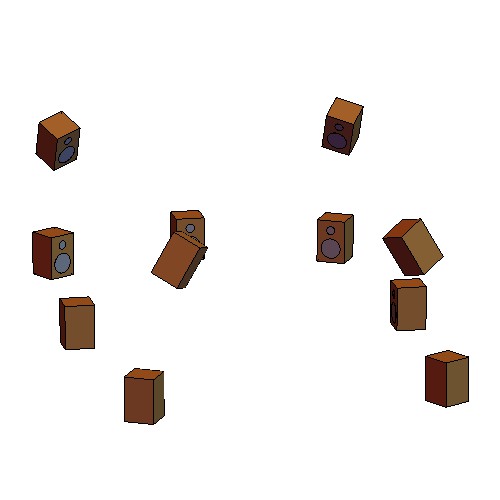
So Dolby Atmos works
- Dolby Atmos combines a channel-based and object-oriented Audio source material.
- "Channel-based" means, for each speaker a separate audio track is included. Stereo, Dolby Digital, DTS, and Auro-3D are based, for example, channel.
- The disadvantage here is that the playback system must have exactly the same speakers, as in the case of the one who has created the audio content. Otherwise, you may suffer from localization and realism heavily.
- "Object-oriented" means that a sound source gets its own audio tracks. Meta-data to give then the desired Position or movement of the sound source. So a Mixer can generate in the playback system itself, the required loudspeaker signals.
- There are a lot of small drawbacks: firstly, the sound must be calculated either in real time or for each cinema individually pre-calculated.
- On the Other hand, the data to be transmitted are very large, for example, if instead of 7 discrete channels, 128 objects at a time should be played.
- This is done in the Dolby Atmos continue to be used mainly on the lossy AC-4 compression, which also comes with Dolby Digital.
- Dolby Atmos provides a special home cinema, with the directional speakers in the ceiling with sound. The reflection is then to create the impression of an elevated sound sources to the listener.
Latest Videos
Dolby Atmos is based on the classic 5.1 speaker configuration. The Subwoofer is not shown in this and the following illustrations.
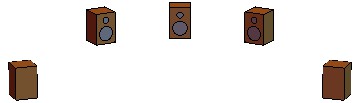
Dolby Atmos is based on the classic 5.1 speaker configuration. The Subwoofer is not shown in this and the following illustrations.
For home theater, in addition, two speakers are directed towards the ceiling. The reflection creates the height impression. Here is a 5.1.2 is shown-System (actually, 5.0.2, because the Subwoofer is missing).
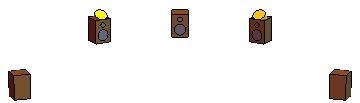
For home theater, in addition, two speakers are directed towards the ceiling. The reflection creates the height impression. Here is a 5.1.2 is shown-System (actually, 5.0.2, because the Subwoofer is missing).
In the Heinkino, but especially in cinema, of course, actually increased-in speaker can be installed, for example, as a 5.1.4 System.

In the Heinkino, but especially in cinema, of course, actually increased-in speaker can be installed, for example, as a 5.1.4 System.
As a basis, but can also be used in a 9.1 Setup.
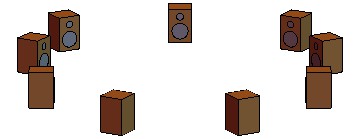
As a basis, but can also be used in a 9.1 Setup.
Two directional speakers to make the Setup to a 9.1.2 System.
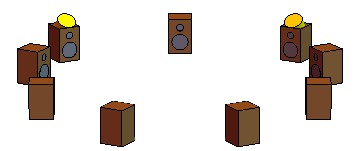
Two directional speakers to make the Setup to a 9.1.2 System.
A 7.1.4 System. For object-oriented audio, the exact number and Position of the speaker is not decisive. As long as the Position of the speaker and of the phantom source is known, you can calculate the required loudspeaker signals individually.
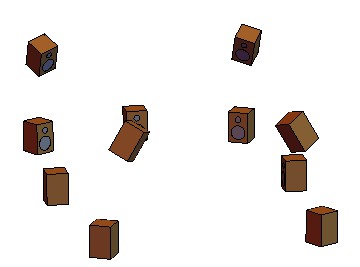
A 7.1.4 System. For object-oriented audio, the exact number and Position of the speaker is not decisive. As long as the Position of the speaker and of the phantom source is known, you can calculate the required loudspeaker signals individually.