What is a poem interpretation?
The poem's interpretation is part of a poem analysis. In the poem, interpreting it is to understand a Text and to explain.
- The poem's interpretation is often confused with a poem analysis. In the most English of the work order is usually work "analyze and interpret". Therefore, the two text types are not clearly distinguished from each other.
- In the poem analysis of the poem into its individual components and to investigate lyrical peculiarities. In the poem's interpretation, however, is trying to make an interpretation. The analysis, therefore, is the basis for the Interpretation.

Poem interpretation writing (image: Pixabay)
Poem interpretation writing: So go ahead
The best way to begin the poem, read through once to gain an Overview of the content. Read the poem, then a second Time thoroughly.
- If you have recorded the content of the poem, you can write the introduction to the poem's interpretation. This should not be longer than two to three sentences to be. It only serves to give the reader the most important information and explain the Situation to him.
- In the introduction you should provide information about the title, author, text type and theme of the poem. In connection with this, also the type of poetry can be given. Also, you should set up a hypothesis that you should confirm at the end of the Interpretation of the arguments, or refute. The hypothesis should include your guess as to the meaning or the statement of work.
- An example of an introduction The poem ... by ... dates back to the year ... the theme would be, for example,: "... . The main message of the author is ...".
- Before Writing the main part you should make a note of the aspects and the arguments of the poem. Then you will drop the main part easier. The main part is made up of content, formal and linguistic analysis of the poem. All arguments should be substantiated with a quote. For example, with the words "... this can be seen in the quote ...".
- After the content analysis, you should move on to the interpretation that is the most important part of the Interpretation. Here it should be explained, what to say of the Poet what. The conclusions you draw, you should associate with the linguistic and formal analysis.
- The final Interpretation can be just as brief and just as the introduction. In the end, you should write a conclusion about the poem. You avoid it, your own opinion, this has no place in the poem, interpretation of anything.
Structure of the poem interpretation (image: Jonas Brandstetter)
Poem: Formal, linguistic and textual analysis
The formal, linguistic and textual analysis, you should bring in the main part below:
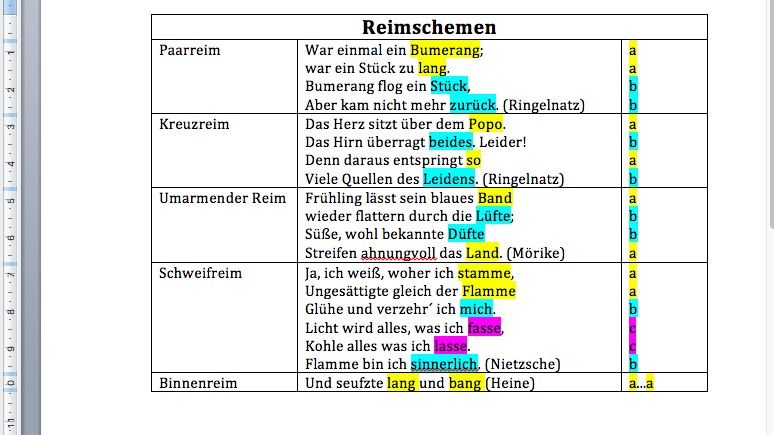
- The formal analysis contains meter, and rhythm, the Verse and the Strophenbau, the rhyme scheme and rhetorical devices.
- The linguistic analysis should include the vocabulary and linguistic style. Also, you should set yourself apart in the context of the linguistic analysis with linguistic features, with the syntax as well as sentence beginnings.
- In the content analysis, you should ask yourself the question, what is the statement the title makes, and what he refers to. You should also make a more detailed explanation of the topic. In this part, conclusions on the content and the Interpretation.
Rhyme schemes for the formal analysis (image: Jonas Brandstetter)
Read our next article about the best Apps for language learning.